


In the last decade, the European Union has faced the migration phenomenon by creating an actual Fortress.
Europe’s closedness towards people who are seeking shelter and protection was caused by the implementation of very restrictive migration policies concerning the reduction of the right to asylum on its territory and the managing of such right, increasingly at border locations, through ‘externalisation’ agreements with non-EU countries; through the creation, by European States, of walls and fences along their external and internal borders.
This occurs on the Mediterranean and overland routes along the Balkan countries.
These tools, whether they are implemented individually or in combination, affect the lives and rights of migrants in a very specific way: an inadequate assessment of the applications for international protection, confinement and detention in transit countries, exposure to inhumane and degrading living conditions, increased violence and abuse during the journey, increased number of deaths.
The document will assess the new walls built in Europe, both physical and virtual, as represented by the ‘externalisation’ agreements with non-European countries. Whether the former or the latter, the effects are the same: the migrant will not be allowed to enter the territory of any EU country.
This mini toolkit can be used by teachers as a tool to build an educational program on the topic of migration, but also directly by students who might want to explore the same topic. The aim is to highlight and bring out how, in the last decades, the response of the European Union and its Member States to the migration phenomenon has been characterized by a strict policy of closedness to prevent migrants from entering Europe.
Additionally, outside the toolkit’s content, the topic could be further explored and analyzed using multidisciplinary resources, such as movies, documentaries, or books. These, with different points of view, highlight the consequences of European policies on the lives and rights of migrants, offering much scope for discussion and confrontation in class.
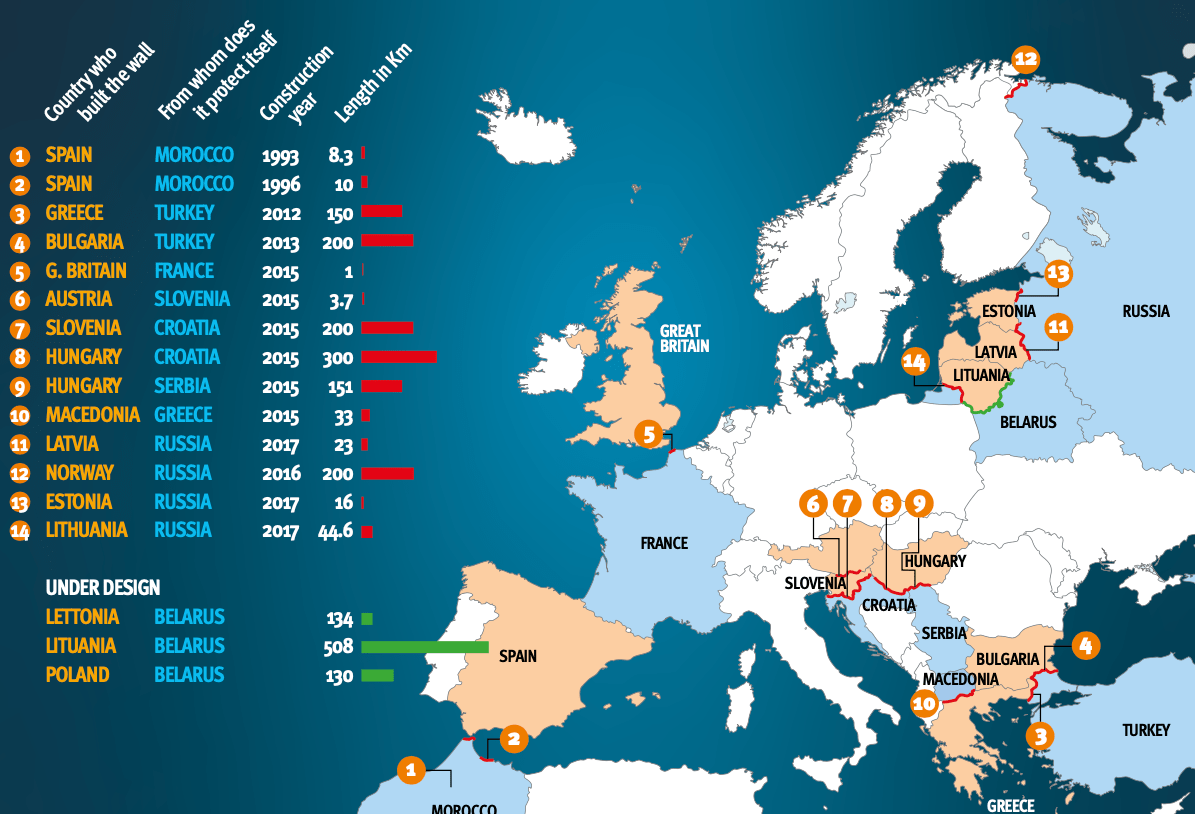
A specific workshop activity is included at the end of the document, which students can work on in class, with facilitation by teachers. The activity, starting by analyzing the barriers that have been built in Europe, has the objective of identifying the possible reasons behind them and, consequently, verifying and ascertaining whether or not they are well-founded through a collective discussion and a participative approach.